Celebrating ADHD Awareness Month and the Launch of the ADHD Center of Minnesota
October is ADHD Awareness Month, so it’s a perfect time to celebrating something deeply meaningful to me: the launch of the ADHD Center of Minnesota! This center has been a long-time dream, a place where ADHD isn’t pathologized or minimized, but understood, supported, and even celebrated. Whether you’re newly diagnosed, or wondering if you (or someone you love) is ADHD, my hope is that this center becomes a place of clarity, connection, and growth.
For many late-diagnosed ADHDers, life has felt like an endless puzzle: why does everything seem harder than it should? Why do others seem to effortlessly do what takes us immense effort? When an ADHD diagnosis finally arrives, it can feel like stepping out of a cocoon. We realize that we were never broken, just wired differently. And we’re ready to try flying.
This article explores why we chose the butterfly as our symbol and how it reflects the journey many ADHDers experience as they move from confusion and self-doubt toward understanding and self-acceptance.

The ADHD Butterfly: A Community-Born Symbol of Transformation
The ADHD butterfly symbol didn’t come from a branding agency or medical organization. It first took flight in online ADHD communities. In particular, it seems to have originated from one Facebook Group where thousands of adults (who were discovering their ADHD identity for the first time) were responding to a prompt about what imagery resonated with lived ADHD experience.
Members began sharing butterfly images to express what words often couldn’t. This is how it feels: the flutter of attention, the restless movement of ideas, the intensity of emotion, and the longing for transformation. For many, the butterfly captured the creativity, energy, resilience, and possibility that coexist alongside the challenges of ADHD.
This quickly evolved into a shared language of hope and self-compassion, and also helped people make a profound shift in recognizing that ADHD is usually a difference and not a deficit.“The butterfly has become an emblem of possibility, new birth, and and personal growth. Many view it as a reminder that ADHDers don’t need to change who we are, but instead deserve the space to unfold into who we’ve always been.
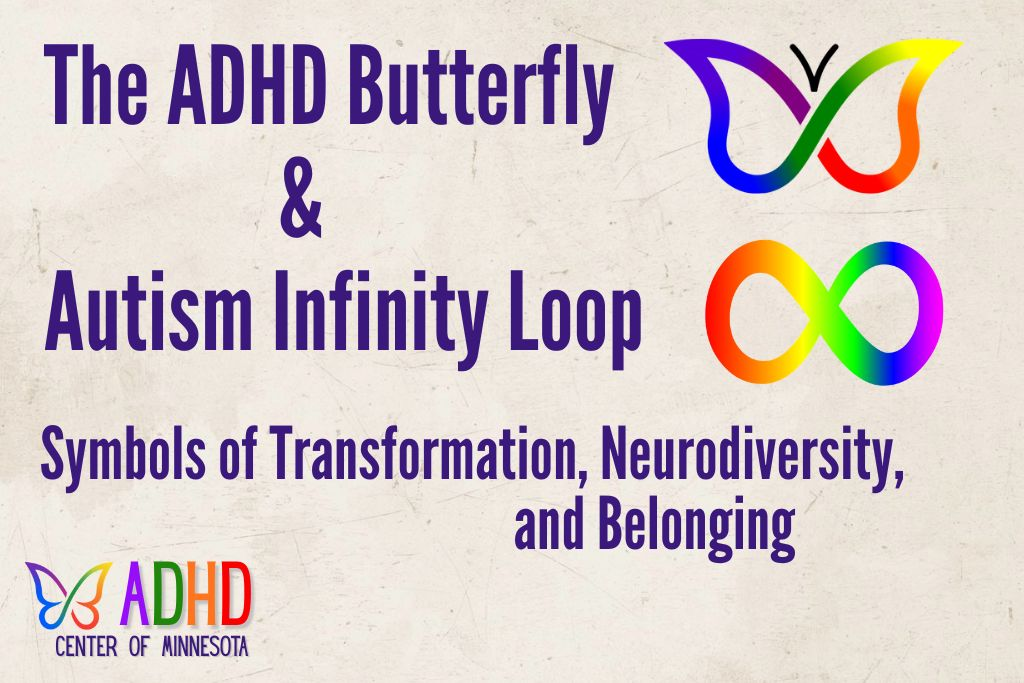
Here is the “official” ADHD Butterfly Symbol that many use today.

At the ADHD Center of Minnesota, we see the butterfly not just as a beautiful image, but as a metaphor for our approach: respectful, growth-oriented, rooted in identity and possibility (rather than correction or stigma). We get to witness people move from shame and struggle to pride and empowerment every day.
The Autism Infinity Loop: Infinite Diversity and Pride
For the autistic community, the rainbow infinity loop has become the most widely recognized symbol of autism acceptance and pride. Created by autistic advocates, the infinity shape represents endless diversity and infinite potential, while the rainbow colors highlight the vast spectrum of strengths and experiences within the community.

For many, this newer symbol has largely replaced the older puzzle piece, which can be perceived as stigmatizing and otherwise problematic. They perceive it to suggest that autism is something incomplete or in need of fixing. Some still find positive meaning in the puzzle piece, but for many the infinity loop better reflects what autism truly represents: whole, valuable, and endlessly varied.
You might also see a gold infinity loop symbol. This was first introduced in 1998 by sociologist Judy Singer, who coined the term neurodiversity. The “Au” in gold’s chemical symbol (Au) nods to the first two letters in autism, and can represent how valuable and special autism is.

The AuDHD Symbol: Where the Two Meet
Many people discover they identify with both ADHD and autism. When the autism infinity loop is layered over the ADHD butterfly, the two images merge to form what’s some recognize as the Au/ADHD symbol or AuDHD symbol.

It’s can be a beautiful representation of the overlap between ADHD and autism, two forms of neurodivergence that often coexist, interact, and enrich one another. For late-diagnosed adults, this combination often feels deeply personal. It captures that experience of clarity: the sense of finally understanding your lifelong patterns, sensitivities, and strengths.
At the ADHD Center of Minnesota, while our work is centered on ADHD our values are also proudly autistic-affirming and neurodiversity-affirming. We’re continually working toward allyship and accessibility, so that every neurodivergent person feels safe, respected, and seen here.
The icon that we created centers the ADHD experience (on the far right in the image below), while also being inclusive to autism experience. Our butterfly gives nod to the autism infinity symbol and incorporates the reality of AuDHD of many of our clients.

The Metamorphosis: Turning Understanding Into Growth
A caterpillar doesn’t become a butterfly by trying harder. It transforms by finding a safe space where change can happen naturally.
That’s what we strive to offer at the ADHD Center of Minnesota—a cocoon for transformation.
Through diagnostic testing, therapy, and ADHD-focused coaching, we help people understand their brains, release the shame of feeling “too much” or “not enough,” and discover the strengths that have been there all along.
Our goal isn’t to “fix” ADHD. It’s to help you thrive with it—to move from coping to creating, from self-doubt to self-trust, from camouflage to color.
This is what it looks like when a caterpillar finds its wings.
If You’re Wondering Whether ADHD Is Part of Your Story
Many adults spend years trying to explain their struggles through willpower, laziness, anxiety, perfectionism, burnout, or personal failure.
Sometimes the missing piece is simply understanding how their brain works.
Whether you’re exploring ADHD for the first time, wondering about autism or AuDHD, or looking for a deeper understanding of yourself, we’d be honored to help.
Your Next Steps
Schedule a Free 15-Minute Consultation with Dr. Nate Page →
Ask questions, learn about the assessment process, and explore whether testing may be a good fit for you.
Learn More About Adult ADHD & Autism Assessments →
Explore our comprehensive diagnostic evaluation process and what you’ll receive as part of your assessment.
Stay Connected
Join our mailing list (below) for occasional updates, resources, articles, and announcements from the ADHD Center of Minnesota.
We promise our updates will be as ADHD-friendly as we are: infrequent, spontaneous, and probably sent at the last possible minute when we suddenly realize that we planned something amazing but forgot to advertise it. 🙂
(We can’t promise consistency. But we can promise heart.)


Meet Dr. Nate Page

Nate Page has some fancy titles (PhD, Licensed Psychologist, Certified Group Psychotherapist), and is also proudly ADHD. He understands firsthand the challenges and benefits that come with an ADHD nervous system (such as inattention/hyperfocus, low motivation and hyperactivity, rejection sensitivity, chronic self-blame, perfectionism and internalized shame).
Today, most of Nate’s clinical work focuses on adult ADHD and autism diagnostic evaluations. He is licensed in 42 states through PsyPACT and is known for providing high-quality, neurodiversity-affirming assessments with fast turnaround times (3–7 days) and no waitlist.
Nate’s training and experience focus on understanding how ADHD often shows up differently across individuals and throughout the lifespan. In fact, most adults do not fit the stereotypical ADHD presentation. Dr. Page frequently evaluates women, gender-diverse individuals, high-masking adults, college students, therapists, and professionals whose ADHD may have gone unnoticed because they appeared successful, organized, or “high functioning” from the outside.
Many therapists, physicians, and psychiatric providers throughout Minnesota refer clients to Dr. Page for evaluations when the diagnostic picture is complex or unclear. The assessments are designed not only to determine whether ADHD is present, but also to carefully differentiate ADHD from other overlapping concerns such as anxiety, depression, trauma/PTSD, autism, OCD, burnout, or other conditions that may affect attention, motivation, and daily functioning.